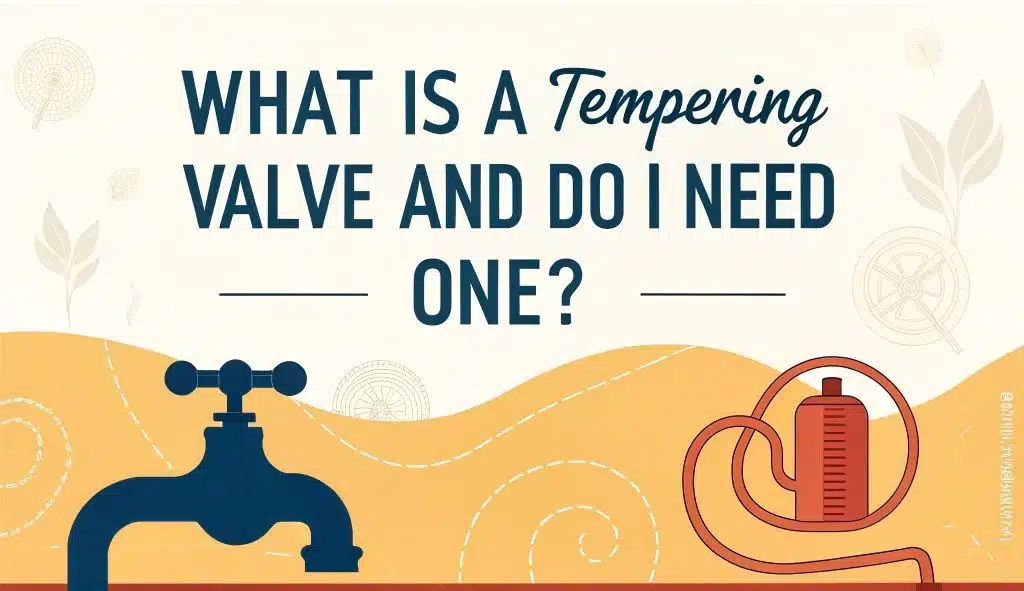
If your hot water feels dangerously hot — or you’re replacing your hot water system — you’ve probably heard about tempering valves. This guide explains exactly what a tempering valve is, how it works, where it’s located, and whether Australian law requires one in your home.
Quick answer: A tempering valve mixes hot and cold water to deliver safe water at around 50°C from your taps — preventing scalds for children and elderly people.
What is a Tempering Valve?
A tempering valve is a three-way mixing device fitted to your hot water system. It blends hot water from your storage tank with cold water before it reaches your taps, keeping the outlet temperature at a safe and consistent level — typically 50°C.
Without one, water leaving a storage tank heater can exceed 70°C. At that temperature, a third-degree burn takes less than half a second. A tempering valve eliminates that risk.
Key facts:
- Maintains temperature within ±3°C of the set point
- Suitable for gas, electric, solar and heat pump storage systems
- Required by law in most Australian homes with storage tank systems
- Lifespan of 5–8 years with regular maintenance
How Does a Tempering Valve Work?
A tempering valve has three connections — a hot water inlet, a cold water inlet, and a mixed water outlet. Inside the valve, a thermostatic element continuously senses the water temperature and adjusts a piston to control how much hot and cold water enters the mix.
Here’s the step-by-step process:
- Hot water enters from your storage tank (often 60–70°C)
- Cold mains water enters through the second inlet
- The thermostatic element reads the blended temperature
- The piston adjusts automatically to hit the target — usually 50°C
- Tempered water exits to your taps at a safe temperature
This adjustment happens continuously, even when someone flushes a toilet or runs another tap simultaneously — so the temperature stays stable throughout your home.
Where is the Tempering Valve Located?
Your tempering valve is typically located at the outlet of your hot water heater or storage cylinder — before the water enters your household pipes. It sits between the hot water tank and the rest of your plumbing.
In most Australian homes you’ll find it:
- Mounted directly on or near the hot water unit
- Inside the hot water cupboard or near an external hot water system
- At the point where hot and cold pipes first connect after the tank
If you’re unsure where yours is, a licensed plumber can locate and inspect it during a routine service visit.
Australian Regulations for Tempering Valves
Is a tempering valve required by law?
Yes — in most cases. The Plumbing Code of Australia requires tempering valves in homes with storage tank hot water systems. The legal maximum outlet temperature for bathrooms and laundries is 50°C.
State-by-state requirements:
| State/Territory | Requirement |
|---|---|
| South Australia (SA) | Required — max 50°C at outlet |
| Queensland (QLD) | Required — max 50°C at outlet |
| Western Australia (WA) | Required — max 50°C at outlet |
| Victoria (VIC) | Required — max 50°C at outlet |
| NSW | Required — max 50°C at outlet |
Exception: Instant/tankless hot water systems do not require a tempering valve as they heat water on demand and don’t store it at high temperatures.
When did tempering valves become law in Australia?
Tempering valves became mandatory under the Plumbing Code of Australia when it was updated to align with AS/NZS 3500. Requirements were rolled out progressively across states from the early 2000s. If your home was built or had its hot water system replaced after 2000, it should already have one fitted.
Types of Tempering Valves — Colour-Coded by System
Australian tempering valves use colour-coded caps to match the correct valve to your hot water system type:
| Cap Colour | Hot Water System Type |
|---|---|
| Orange | Solar or heat pump storage tanks |
| Green | Gas-powered hot water units |
| Blue | Electric water heaters |
| Black | Large-capacity systems |
Using the wrong valve for your system can affect temperature accuracy and efficiency — always confirm with your plumber.
Tempering Valve vs Thermostatic Mixing Valve (TMV) — What’s the Difference?
Both devices mix hot and cold water to deliver safe temperatures, but they serve different purposes:
| Feature | Tempering Valve | Thermostatic Mixing Valve (TMV) |
|---|---|---|
| Accuracy | ±3°C | ±1°C |
| Typical use | Residential homes | Hospitals, aged care, childcare |
| Max outlet temp | 50°C | 45°C |
| Cost | Lower | Higher |
| Australian standard | AS 4032.1 | AS 4032.3 |
For standard Australian homes, a tempering valve is sufficient and compliant. TMVs are required where higher-risk users are present — such as hospitals, aged care facilities, and childcare centres where even a small temperature variation could cause harm.
Tempering Valve Installation — What’s Involved?
Installation must be carried out by a licensed plumber — it is not a DIY job under Australian law.
The installation process includes:
- Selecting the correct valve (matched to your hot water system type)
- Fitting isolating valves, check valves, and a line strainer
- Connecting the three inlets — hot, cold, and mixed outlet
- Adjusting the valve to deliver water at 50°C
- Testing outlet temperature to confirm compliance
- Fitting a pressure-reducing valve if your home has high water pressure
How to adjust a tempering valve
If your water is running too hot or too cold, the valve may need adjustment. There is a small adjustment knob on the valve body. However, any adjustment should be made by a licensed plumber to ensure it remains within Australian regulatory limits.
Tempering Valve Maintenance — How Long Do They Last?
Most tempering valves last 5–8 years with regular maintenance. Common issues include:
- Mineral build-up — especially in areas with hard water (common across Adelaide, Perth and parts of Brisbane). A water filter on the inlet can significantly reduce this
- Leaks — caused by worn seals or incorrect pressure
- Temperature fluctuations — sign the thermostatic element is failing
- Complete failure — water runs either scalding hot or cold
Have your tempering valve inspected every 1–2 years by a licensed plumber. Regular flushing of pipes also helps prevent mineral deposits from building up inside the valve.
Do You Need a Tempering Valve? — Quick Checklist
You almost certainly need one if:
- Your home has a storage tank hot water system (gas, electric, solar or heat pump)
- Your hot water system was installed or replaced after 2000
- You live in SA, QLD, WA, VIC, or NSW
You may not need one if:
- You have an instant/continuous flow hot water system
- Your property is already fitted with a thermostatic mixing valve (TMV)
Signs your existing tempering valve needs replacing:
- Water at taps is inconsistently hot or cold
- You notice leaks near the hot water unit
- Your valve is over 8 years old
- A plumber has flagged it during a recent inspection
Need a Tempering Valve Installed or Replaced in Adelaide, Perth or Brisbane?
Same Day Trades provides same-day tempering valve installation, adjustment and replacement across Adelaide, Perth and Brisbane. Our licensed plumbers carry stock of all major valve types — so there’s no waiting around.
Call 1300 632 094 — no call-out fee, $55 OFF same-day repairs.
Book a Plumber in Adelaide | Book a Plumber in Perth | Book a Plumber in Brisbane
Frequently Asked Questions
What is a tempering valve on a hot water system?
A tempering valve mixes hot water from your storage tank with cold mains water to deliver safe, tempered water at around 50°C from your taps, preventing scalds.
How does a tempering valve work?
The valve blends hot water from your heater with cold water using a thermostatic element that continuously adjusts the mix to maintain a steady temperature.
Where is the tempering valve located?
It is located at the outlet of your hot water heater or storage cylinder, usually inside a hot water cupboard or mounted directly on the unit.
Do I need to adjust my hot water tempering valve?
If the water is too hot or too cold, adjustment may be required. In Australia, this must be done by a licensed plumber to ensure compliance.
Are there regulations for installing a tempering valve in Australia?
Yes, regulations across SA, QLD, WA, VIC, and NSW require tempering valves on storage hot water systems with a maximum outlet temperature of 50°C.
What’s the difference between a tempering valve and a thermostatic mixing valve?
A tempering valve has an accuracy of about ±3°C and is suitable for homes, while a thermostatic mixing valve offers higher precision of ±1°C and is used in hospitals and childcare facilities.
When did tempering valves become law in Australia?
Tempering valve requirements were introduced in the early 2000s under the Plumbing Code of Australia, aligned with AS/NZS 3500 standards.
How long does a tempering valve last?
Most tempering valves last between 5 to 8 years. In hard water areas like Adelaide and Perth, mineral build-up may reduce lifespan, but a water filter can help extend it.