
If your bathroom or kitchen sink drains slower than usual, the problem might be more than just a few tufts of hair and food particles.

A ceiling fan that wobbles, hums or will not start is both annoying and, if the mounting is loose, unsafe. Our licensed electricians diagnose and repair all common ceiling fan faults, from a failed capacitor to a noisy motor.
We repair and replace ceiling fans across Brisbane, Perth and Adelaide, with same-day service and upfront fixed pricing.
We are local, licensed electricians who do this work every day, so we get it right the first time, with no mess and no shortcuts on safety.
You get safe, tidy, guaranteed workmanship every time, and honest advice on what your home actually needs.

Ceiling fans are simple, reliable appliances, but they do develop faults over time. We repair the full range of ceiling fan problems, including:
Whatever the problem, we diagnose the real cause and repair it safely, or advise replacement if the fan is worn out or beyond economical repair.
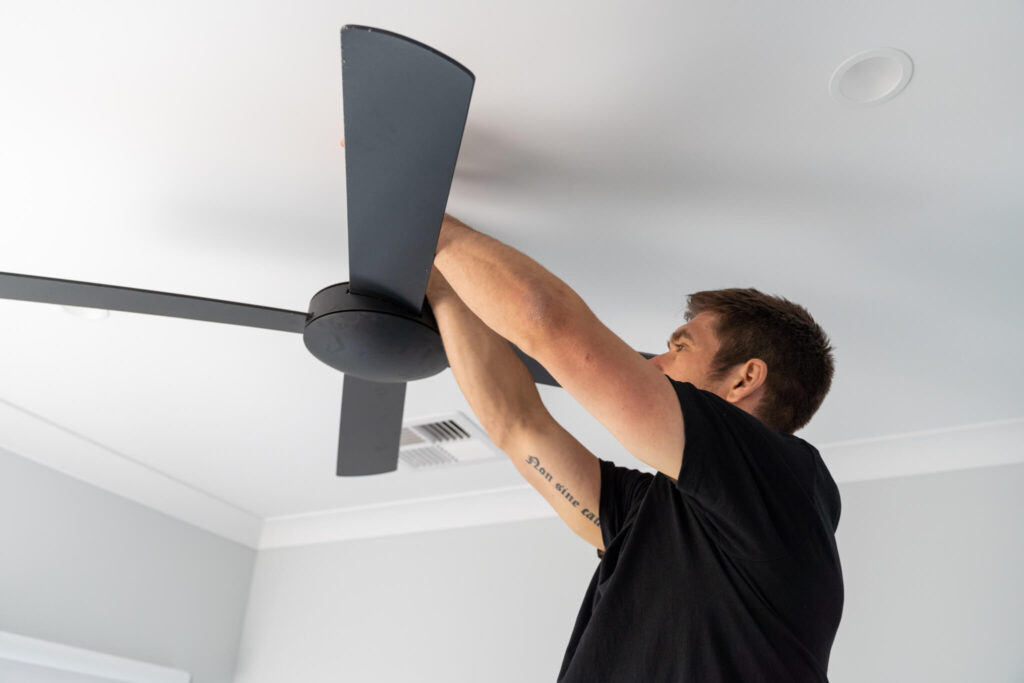
A wobbling ceiling fan is the most common complaint, and it is usually a sign of an installation or balance problem rather than a dangerous fault, though it should not be ignored, as a bad wobble can loosen the mounting over time. Common causes are a loose mounting or bracket, blades that are out of balance, bent, or have loosened at the fixings, dust build-up on the blades, or a fan that was never anchored firmly enough to the ceiling joist. We inspect the mounting, re-secure and balance the fan, and check the blades and fixings, so it runs smoothly and quietly again, rather than shaking every time you turn it on.
A ceiling fan that hums, buzzes, clicks, rattles or grinds is telling you something needs attention. A humming or buzzing noise can come from the motor, a failing capacitor, or an incompatible speed controller or dimmer wired to the fan. Clicking or rattling is often loose blades, screws or a loose mounting. Grinding can indicate worn motor bearings, which usually means the fan is near the end of its life. We identify the source of the noise and fix it, whether that is tightening and balancing, replacing a capacitor, correcting the controller, or advising replacement if the motor bearings have worn out.
If your ceiling fan has stopped working entirely, the cause could be the fan, the switch or remote, or the circuit. Before calling, it is worth checking whether the wall switch is on, whether the remote needs a new battery, and whether a breaker or safety switch has tripped at the switchboard. If the fan still will not run, the fault may be a failed capacitor (a common cause, which often stops a fan starting), a motor fault, a wiring or connection problem, or a faulty switch or remote receiver. We trace the fault methodically and repair it, or advise replacement if the motor has failed, so your fan runs again.
One of the most common ceiling fan faults is a failed capacitor, the component that helps the motor start and controls the fan speeds. When the capacitor fails, the fan may not start at all, start only if you give the blades a push, run very slowly, or get stuck on one speed. The good news is that a capacitor is a repairable part, so replacing it is usually far cheaper than a new fan, and it restores normal operation. We diagnose whether a capacitor fault is behind your fan not starting or running slowly, and replace it with the correct part, bringing your fan back to full working order across all its speeds.
A fan that runs slowly on all settings, or is stuck on one speed, usually points to a capacitor fault, since the capacitor controls the speed windings. It can also be caused by a faulty speed controller or wall control, a wiring issue, or a motor problem. A fan that has gradually slowed over time may have a worn motor. We test the fan to find out whether it is the capacitor, the controller, the wiring or the motor, and repair the fault, most often a capacitor replacement, so your fan gives you its full range of speeds again rather than a feeble, single-speed breeze.
Many ceiling fans are operated by a remote or a wall control, and these can develop faults of their own. A remote may stop working because of a flat battery, a lost pairing with the receiver, or a failed receiver unit in the fan. A wall control can fail or develop a fault in its switching. Before assuming the fan is broken, it is worth checking the remote battery and trying to re-pair it. If the control or receiver has genuinely failed, we can replace it, or convert the fan to a different control method if you prefer. We sort out remote and wall control problems so you can operate your fan reliably again.
If your fan still spins but the built-in light has stopped working, the problem is usually with the light rather than the fan itself. Common causes are a blown globe, a failed LED module, a faulty light switch or remote function, or a wiring connection in the light fitting. Often it is a simple globe or module replacement. If the fan and light are controlled separately by remote or wall switch, the fault may be in that control. We diagnose why the fan light has failed and repair it, whether it is the globe, the module, the control or the wiring, so your combined fan and light works fully again.
Whether to repair or replace depends on the fan and the fault. If the fan is reasonably modern and the problem is a repairable part, a capacitor, a control, a light module, or a balance and mounting issue, a repair is usually the best value. If the fan is old, the motor bearings are worn or grinding, or it is a noisy, inefficient older model, replacing it with a modern, quiet, energy-efficient DC fan often makes more sense. We give you an honest assessment and a price for both, so you can decide. Often a simple, affordable repair gets a good fan working again; sometimes an upgrade is the smarter choice.
If your old fan is noisy, inefficient or beyond economical repair, upgrading to a modern DC-motor fan is well worth considering. DC fans use up to 70% less power than older AC fans, are noticeably quieter, offer more speed settings, start and stop more smoothly, and usually come with a remote. Because the wiring and mounting point are already there, replacing an old fan with a new DC model is straightforward. For bedrooms especially, the quiet operation is a big improvement. We can remove your old fan and install an efficient new one, giving you better performance, lower running costs and quieter nights. See our ceiling fan installation service.
Ceiling fan repairs are generally affordable, especially common fixes like replacing a capacitor, re-securing and balancing a wobbling fan, or sorting a control fault. The cost depends on the fault and the parts needed. A repair is almost always cheaper than a new fan, unless the motor has failed, in which case replacement is the better value. Replacing a fan is also a reasonably quick job since the wiring is already in place. We diagnose the problem and give you an upfront fixed price before we start, so you know whether a repair or a replacement is the smarter spend, with no surprises.
A slight wobble is usually just a balance or dust issue and not immediately dangerous, but a significant, persistent wobble should not be ignored. Over time a bad wobble can loosen the mounting, the blades or the fixings further, and in the worst case a poorly mounted fan could become unsafe. A fan that wobbles badly, makes grinding noises, or was never properly secured to a ceiling joist is worth having checked, particularly if it is over a bed or a seating area. We inspect the mounting and balance, re-secure the fan properly, and give you peace of mind that it is safe as well as smooth and quiet.
A broken, wobbling or noisy ceiling fan is both annoying and, in summer, something you want fixed fast. We offer quick service and same-day appointments where we can across Brisbane, Perth and Adelaide, with phones answered around the clock. Our electrician will diagnose the cause of your fan problem, repair it on the spot where possible, and advise if a replacement is the better option. Whether it is a capacitor, a control, a balance issue or a worn motor, we will get your fan, and your breeze, back in working order quickly, with an upfront price.
Repairing a ceiling fan involves electrical connections and work overhead, so it is licensed electrical work best left to a professional, both for safety and to fix the fault correctly. Our licensed electricians diagnose and repair wobbling, noisy, slow and dead fans, replace capacitors and controls, fix fan lights, and re-secure and balance fans, all to the AS/NZS 3000 standard, and we install efficient new fans where replacement is the better choice. You get honest advice, upfront fixed pricing, tidy work, same-day help where we can, and guaranteed workmanship. For ceiling fan problems, we cover Brisbane, Perth and Adelaide.
Common causes are a failed capacitor, a faulty switch or remote, or a wiring fault. Many are repairable, and we can diagnose it quickly.
Usually loose mounting, unbalanced or bent blades, or a worn bracket. A wobbling fan is unsafe, so have it checked and secured.
Worn bearings, loose screws, or a failing motor or capacitor. We find the source and repair or replace the part.
That is often a failed capacitor, which is a common and repairable fault. An electrician can replace it.
Minor faults are cheap to repair. If the motor is burnt out or the fan is old, a new DC-motor fan is often better value.
You can clean blades and tighten visible screws, but wiring, capacitor and motor repairs are licensed electrical work.
It depends on the fault, from a capacitor to a new fan. We give you an upfront fixed price.
Yes. We can usually repair or replace ceiling fans the same day across Brisbane, Perth and Adelaide.

If your bathroom or kitchen sink drains slower than usual, the problem might be more than just a few tufts of hair and food particles.

A hot bath is always refreshing, But sometimes when blockages occur, the situation is a lot worse than what meets the eyes, and your blocked

Leaves, plants, twigs, pine needles, and roofing cement are common causes of blocked downpipes. And if not cleared in time, this will eventually lead to

Blocked Kitchen Sink Grease, food debris, and soap residue often build up in kitchen pipes and lead to blocked kitchen drains. Getting rid of these
Blocked drains in your house are a nuisance you are better off without. Grease, fat, oil, hair and even wipes stick to your pipe walls
If there is anything more taxing than doing laundry, it is dealing with a blocked laundry drain. Over time, gunk and debris build-up can lead

If you are facing issues with a blocked stormwater drain, our experts at Same Day Trades are here to help you through this dilemma. We

A blocked drain will always hinder your perfect shower experience. Well, it’s time to get rid of that problem, and you’ve come to the right

With hundreds of 5 star reviews, we’re the local tradesmen you can trust.

We make sure you know exactly what you are paying for ahead of time.
You’re in safe hands as our tradesmen are fully licensed and insured to do your job.


Our work will be free of defects in workmanship and workmanship will be warranted for life.

We offer convenient booking times that can be worked around your schedule.

We take calls 24 hours a day and 365 days a year so that we’re always available to be of service.

With hundreds of 5 star reviews, we’re the local tradesmen you can trust.

We make sure you know exactly what you are paying for ahead of time.
You’re in safe hands as our tradesmen are fully licensed and insured to do your job.

Our work will be free of defects in workmanship and workmanship will be warranted for life.

We offer convenient booking times that can be worked around your schedule.

We take calls 24 hours a day and 365 days a year so that we’re always available to be of service.